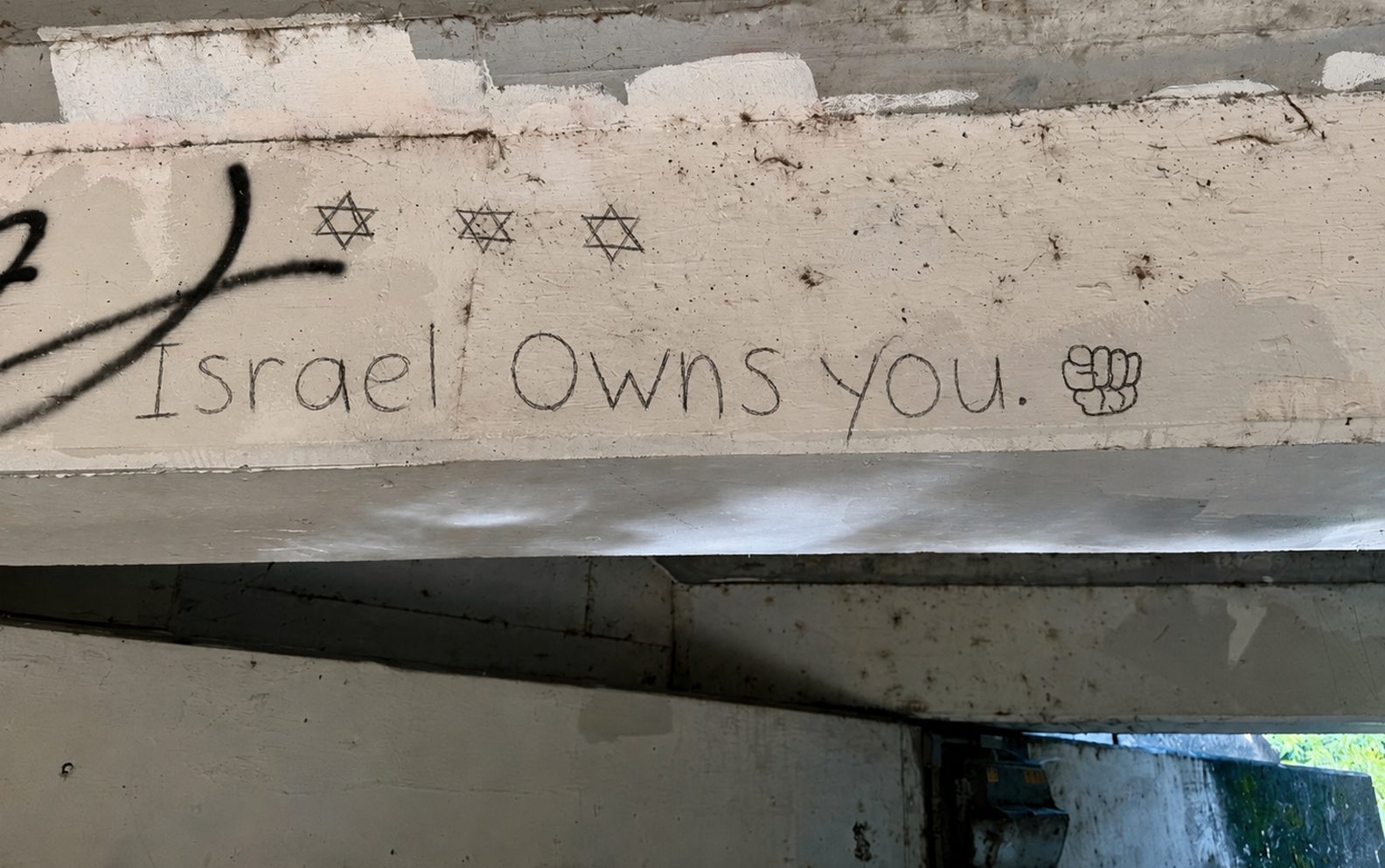
Living in Cleveland, Tennessee, certain things become part of the landscape. Churches, Christian ministries, colleges, denominational offices, and mission organizations are deeply woven into the identity of this community. Support for Israel and concern for the Jewish people are also common throughout the region. That is part of what made something I encountered beneath a local bridge so striking. Written faintly across the concrete were the words “Israel owns you,” accompanied by several Stars of David.
The graffiti itself was easy to miss. There was no crowd gathered around it, no demonstration, and nothing that would have drawn much public attention. Most people passing through the area could probably have walked by without noticing it. Yet because Cleveland is my home, seeing those words here felt different from encountering antisemitism through a news report or social media post. I have traveled to Israel, spent considerable time studying its history, and engaged in many conversations concerning Israel and the Jewish people. Still, seeing that language written anonymously beneath a bridge only minutes from home made something that often feels distant suddenly feel very close.
One piece of graffiti should never be used to define an entire community. I do not believe those words represent Cleveland, and it would be unfair to suggest otherwise. This city is much larger than one anonymous message written on concrete. Yet dismissing it completely would also miss something important. Prejudice does not need to be widespread before it deserves our attention. Sometimes it appears quietly, in places where almost no one is looking.
The phrase “Israel owns you” carries a history far larger than its few words suggest. When placed alongside Stars of David, the message points toward an old and recurring form of antisemitic suspicion: the idea that Jews or Jewish interests exercise hidden control over people, institutions, finances, media, governments, or society itself. That accusation is not new. Across generations, Jewish communities have repeatedly been portrayed as possessing unusual influence behind world events. The language may change with time, but the pattern remains familiar. Complex political, economic, and social realities are reduced to the idea that Jews are somehow operating behind the scenes.
This is what makes the imagery beneath the bridge significant. The Star of David is one of the most recognizable symbols of Jewish identity. Pairing that symbol with language about ownership and control does more than express anger or frustration. It connects Jewish identity itself with the idea of hidden domination. I do not know who wrote those words, and I cannot know that person’s intentions or level of understanding. What can be said, however, is that the message itself carries a well-established antisemitic meaning, regardless of whether the person who wrote it fully understood that history.
One of the reasons antisemitism has survived for so long is its ability to adapt its language. The accusations may sound different from one generation to another, but certain themes repeatedly return. Jewish people are portrayed as unusually powerful, secretly coordinated, financially controlling, politically manipulative, or somehow responsible for events far beyond the actions of any individual Jewish person. This kind of thinking becomes dangerous because it treats millions of people as though they share one motive, one agenda, and one source of power. Individual identity disappears beneath collective suspicion.
That is why phrases like “Israel owns you,” especially when combined with Jewish symbols, deserve attention. They do not simply express dislike. They reproduce an old way of imagining Jewish people as a hidden force operating behind ordinary life. The fact that these ideas are old does not mean everyone who repeats them understands their history. In some ways, that makes historical awareness even more important. Prejudice becomes easier to repeat when people no longer recognize the story behind the language they are using.
For Christians, this should matter deeply. Recognizing antisemitism should be part of loving our Jewish neighbors and refusing ideas that reduce an entire people to suspicion and stereotype. Christian support for Israel should never be reduced to slogans or political identity. It should also include the willingness to recognize antisemitic ideas when they appear, even when they appear quietly and even when they appear in places where we least expect them.
It would be easy to dismiss a few words written underneath a bridge. Perhaps one person wrote them. There is no evidence that the graffiti represents a larger movement in Cleveland, and I would not want to create that impression. But small expressions of prejudice still matter because hatred rarely begins at its loudest point. It often becomes familiar before it becomes extreme. A stereotype is repeated as a joke, an accusation circulates online, or a phrase appears on a wall or beneath a bridge. Eventually, language that should sound troubling can begin to sound ordinary simply because people have heard it often enough.
That does not mean every offensive statement signals an approaching crisis. Exaggeration is not responsible either. We should be capable of acknowledging something troubling without turning one incident into a judgment against an entire community. For me, that balance matters because I care about Cleveland. I know the churches, ministries, families, educators, and community leaders who invest themselves in this city. One anonymous message does not erase any of that. But caring about where we live should never require pretending that prejudice cannot appear here.
Perhaps that is what stayed with me most. Antisemitism often feels distant when we encounter it through history books, international news, or the internet. Then a few words appear beneath a bridge in the city where you live, and the distance disappears. The message beneath that bridge does not define Cleveland, but it did remind me that antisemitism does not always announce itself through large demonstrations, organized movements, or dramatic acts. Sometimes it appears quietly, anonymously, and almost unnoticed.
That is precisely why we should learn to recognize it. The words “Israel owns you” may have occupied only a small space on an aging concrete wall, but the idea behind them belongs to a much longer history. Seeing them in my own community was a reminder that old prejudices can survive in new places and ordinary settings. When hatred shows up close to home, we do not need to exaggerate it, but neither should we pretend we did not see it.
Discover The Israel Christian Nexus
See how pastors and faith leaders have taken the first step toward Israel through the Nexus.