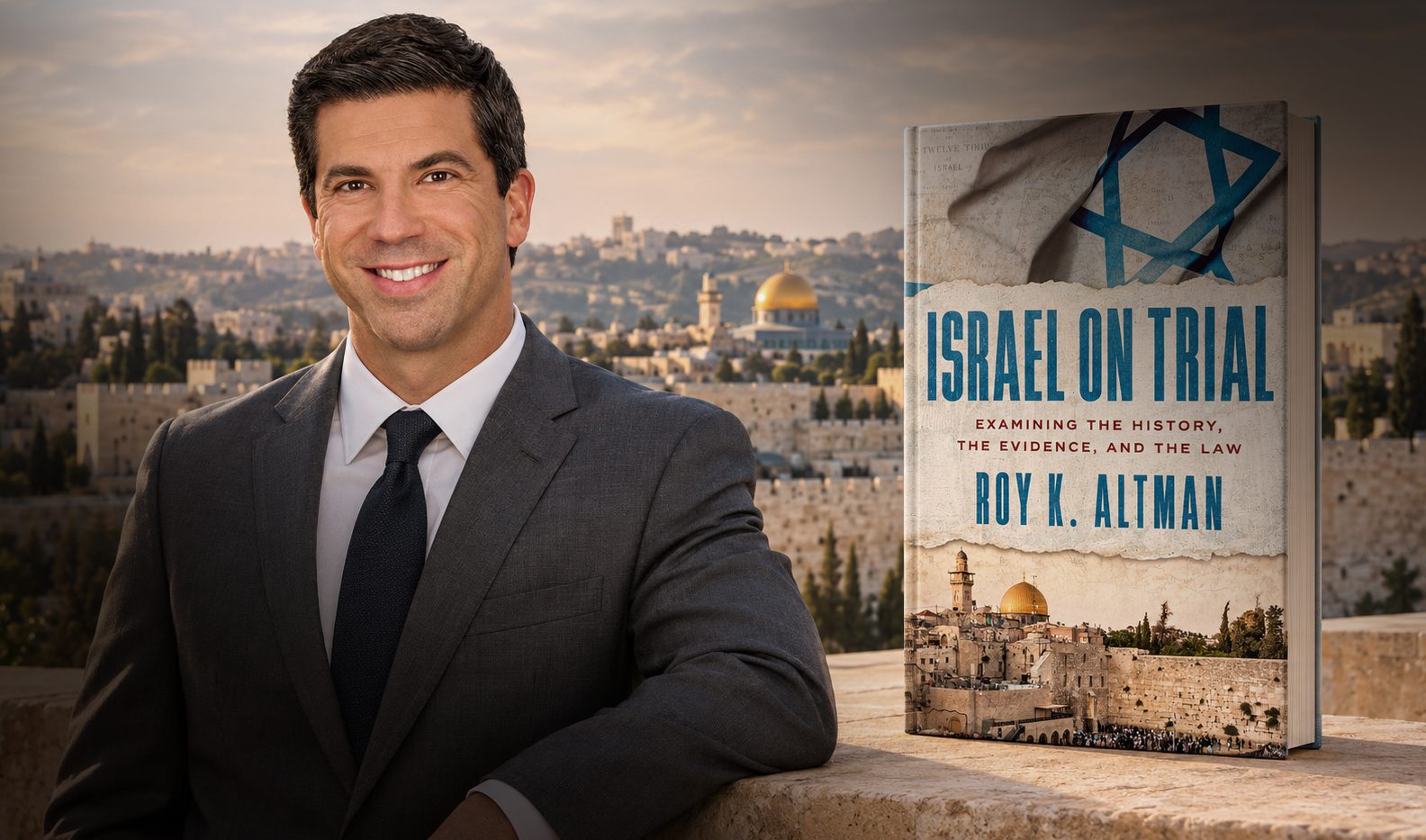
NEXUS BRIEFING WITH JUDGE ROY K. ALTMAN
NOV 6, 2026
How can a pastor respond when a question about Israel arises? The following 18 talking points come directly from the historical examples and legal reasoning presented in Judge Roy K. Altman’s Israel on Trial. Each claim includes three concise responses; the endnotes point to the book for deeper study.
| 01 – Are Jews Colonizers in the Land of Israel? (1) |
• Ancient inscriptions: The Egyptian Merneptah Stele (c. 1205 BCE) names Israel, and the Mesha Stele (c. 840 BCE) identifies Israelite rulers. Both records predate the modern State of Israel by thousands of years.
• Jewish presence over time: Jewish communities remained in Jerusalem, Safed, Tiberias, and even Gaza during centuries of foreign rule. Jewish ties to the land did not begin with modern immigration.
• Shared ancestral roots: Genetic studies have identified common Middle Eastern ancestry among Ashkenazi, Sephardi, and Mizrahi Jewish populations. These findings provide additional evidence of the Jewish people’s historical connection to the land of Israel and complement the archaeological record.
| 02 – Was the Establishment of Israel Illegitimate? (2) |
• The UN partition plan: In 1947, UN Resolution 181 recommended separate Jewish and Arab states. Jewish leaders accepted the proposal; Arab leaders rejected it. The proposed Arab state was not established.
• International recognition: Israel declared independence on May 14, 1948, and joined the United Nations on May 11, 1949, becoming its 59th member state.
• The statehood test: The Montevideo framework considers population, territory, effective government, and foreign relations. By 1948, Israel had residents, government institutions, territory, and a foreign ministry.
| 03 – Has Israel Prevented the Creation of a Palestinian State? (3) |
• 1937 and 1947 partitions: The Peel Commission proposed partition in 1937; Jewish leaders accepted its principle while Arab leaders rejected it. In 1947, Jewish leaders accepted UN partition and Arab leaders rejected the plan.
• The 1967 response: After the Six-Day War, Arab leaders meeting at Khartoum issued the “Three No’s”: no peace with Israel, no negotiations with Israel, and no recognition of Israel.
• Later peace proposals: In 2000, Israeli Prime Minister Ehud Barak pursued negotiations for a Palestinian state in Gaza and much of the West Bank. In 2008, Prime Minister Ehud Olmert proposed Palestinian statehood with land swaps, a Gaza–West Bank connection, and arrangements for Jerusalem. Neither effort produced a final agreement.
| 04 – Did Israel Turn Gaza into an Open-Air Prison? (4) |
• The 2005 withdrawal: Israel evacuated roughly 8,000 Jewish residents and dismantled its permanent military bases in Gaza. No permanent Israeli settlements or military bases remained there before October 7, 2023.
• Who ran Gaza: Hamas won the 2006 Palestinian election and took control of Gaza from Fatah in 2007. Before October 7, 2023, Gaza was administered internally by Hamas, not Israeli settlers or military bases.
• Work permits and borders: By 2022, Israel permitted nearly 20,000 Gazans to enter the country for employment, providing access to higher-paying jobs. Meanwhile, Egypt also maintained restrictions along Gaza’s southern border, demonstrating that limitations on movement were not imposed exclusively by Israel.
| 05 – Is Israel an Apartheid State? (5) |
• Voting and representation: Arab citizens account for more than 21% of Israel’s population and have the right to vote, establish political parties, and serve in the Knesset (Israel’s parliament). In 2021, an Arab political party joined Israel’s governing coalition, demonstrating the participation of Arab citizens in the country’s political leadership.
• Courts and public services: Arab citizens can serve on Israel’s Supreme Court and access state-supported education, healthcare, and the courts. In 2000, Israel amended its civil-service law to provide affirmative action for Arab citizens.
• Citizens versus noncitizens: Arab citizens of Israel have the right to vote, participate in elections, and hold public office, while Palestinians living in Gaza and the West Bank generally do not hold Israeli citizenship. Under the Oslo Accords, Palestinians were granted limited self-government in these territories, establishing a separate political framework rather than incorporation into Israel.
| 06 – Is Israel Committing Genocide in Gaza? (6) |
• Civilian precautions and military oversight: Israel issued evacuation warnings, established humanitarian zones, supported polio vaccinations, and used military legal oversight to review operations and investigate alleged misconduct. These measures are relevant when assessing allegations of genocidal intent.
• The legal threshold: The 1948 Genocide Convention requires specific intent to destroy, in whole or in part, a protected national, ethnic, racial, or religious group. Civilian deaths alone do not establish this specific intent.
• Hamas’s military infrastructure: Hamas maintained extensive tunnel networks, weapons facilities, and military positions within densely populated areas of Gaza. Their presence is important when evaluating civilian casualties and distinguishing attacks on military targets from the deliberate targeting of civilians.
SELECTED ENDNOTES
1. Altman, Israel on Trial (Advantage Books, 2026), “Ancient Stones, Modern Claims,” especially discussion of the Merneptah and Mesha stelae and original endnotes 31–42, 257.
2. Altman, Israel on Trial, “Foundations Under International Law,” particularly original endnotes 293–302; see also “The Paths Not Taken,” notes 346–348.
3. Altman, Israel on Trial, “The Paths Not Taken,” especially the discussions of 1937, 1947–48, 1967, 2000, and 2008; original endnotes 341–362.
4. Altman, Israel on Trial, “From Occupation to Withdrawal,” especially the 2005 disengagement, Hamas’s takeover, work permits, and border restrictions; original endnotes 368–382, 391–397.
5. Altman, Israel on Trial, “Beyond Apartheid,” especially the discussions of Arab citizenship, Knesset representation, judicial participation, and public services; original endnotes 421–438.
6. Altman, Israel on Trial, “Genocide,” especially “The Absence of Specific Intent,” the Genocide Convention, the discussion of civilian precautions, and original endnotes 522–531.
Discover The Israel Christian Nexus
See how pastors and faith leaders have taken the first step toward Israel through the Nexus.